

Serious about helping animals? Consider using your career to maximise your impact
If you’re here, there’s a good chance that you’re aware of at least some aspects of animal suffering. Maybe you’ve already taken some action to help them, such as taking care of a companion animal, volunteering for a shelter, or following a plant-based diet.
You also have another means to help animals that perhaps you haven’t thought seriously about: your career.
We believe that your career is probably your biggest opportunity to help animals. And there’s lots of ways you can use your career to help animals:
- You can work in charities that advocate for animals.
- You can work in for-profit companies that compete against animal products.
- You can use your platform in academia or government to advocate for animals.
- You can simply use your career to earn money and donate some of that to effective animal charities.
At Animal Advocacy Careers, we believe that people can do an amazing amount of good for animals — particularly if they consider their career choices carefully, make strategic decisions, and work hard toward their goals.
Why using your career to help animals is so impactful
The obvious reason is the sheer amount of time. Depending where you’re at in your career, you might have 5–50 years to make a difference.
That’s a lot of time! Even if you’re later in your career, you still have many workdays you can commit to improving animals’ lives:
- 5 years: 240 days
- 10 years: 480 days
- 25 years: 1,200 days
- 50 years: 2,400 days
Of course, we tend to think of our careers primarily as a way to earn money and provide for our needs. And that’s perfectly reasonable!
However, it’s possible to find a career that not only provides the money we need to live, but also can improve the lives of countless animals who suffer.
Imagine that you do not just volunteer for two hours a week, but work for an animal advocacy organisation for 40 hours a week. Imagine not only your impact for that week, but also how your skills and expertise build up over time, and how that would help animals in the future. Imagine all the people you can meet, connect with, and convince to do better for animals in years to come. Imagine what those people you impacted could do for animals. And finally, imagine your possible achievements as a team, in an organisation, rather than acting alone as an individual.
The second reason is more depressing: there is so much animal suffering in the world, and we cannot end this without serious effort. There are billions upon billions of animals who experience the worst kinds of pain in factory farms (as well as in the wild). Given how institutionalised and complex the problem is, we can only make progress with concentrated and continued work.
Just consider for a moment how many resources and work hours the animal industry puts in to profit from animals. We cannot expect to even make a dent against this massive institutional problem with casual acts here and there.
To make the biggest difference, deciding which animal advocacy career you pursue is very important
If you really want to help animals, it matters a great deal which area you focus on and which organisations you work with.
Some animal advocacy career paths can be much more impactful than others — even 1,000 times more! This huge difference is due to three main factors:
- How pressing the problems are.
- How promising the solutions to the problems are.
- Your personal fit in a career path.
Some problems are much more pressing than others
There are so many animals in the world that could use our help. It may seem really hard — and even inappropriate — to select some groups of animals to help over others.
But there are huge differences in:
- The numbers of animals affected.
- The amount of suffering between different animal groups.
- How neglected different fields are.
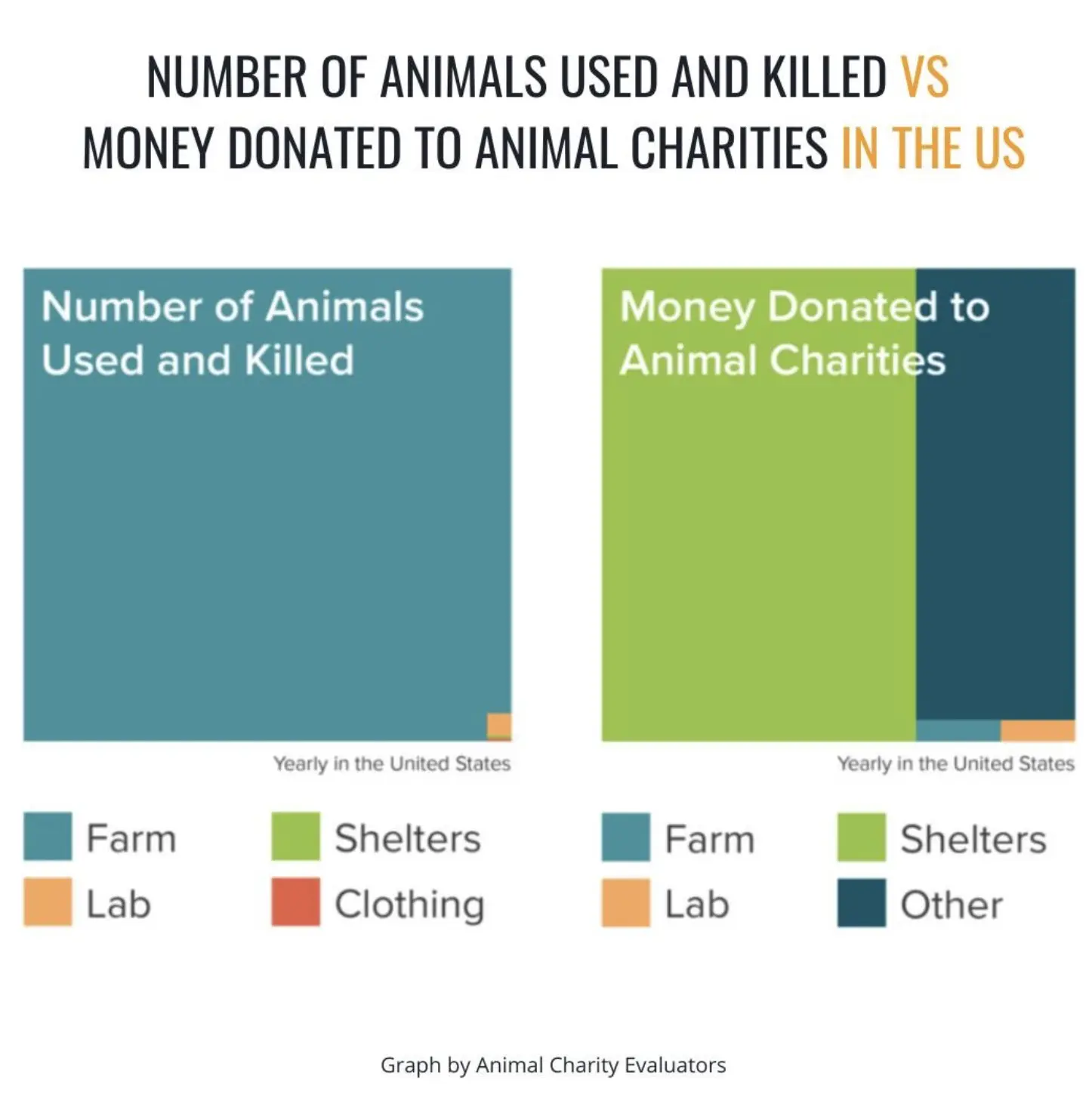
And those really do amount to 1,000 times the difference, or even more. For example, there are 1,000 times more animals reared in factory farms (chicken and fish in particular) than there are companion animals or animals used in labs.
And even more than that, the number of animals who suffer in the wild (invertebrates in particular) may amount to more than trillions.
Despite this, organisations working to reduce factory farm suffering or wild animal suffering don’t have resources proportional to the scale of the problems they’re working on. So by working in a more neglected field, where there is significantly more animal suffering, you could increase your impact by many times.
Some solutions have a better chance of helping more animals
Let’s imagine that you want to spare animals from the worst pains in factory farms. You may want to help by caring for former farmed animals or trying to influence people around you to cut animal products out of their lives. And you may even have some success! But considering the scale of the problem, trying to help animals one by one is just a drop in the bucket. The same goes for trying to convince people one by one to change their habits and values around how they treat animals.
But there may be other ways to help where you have a better chance to really impact a lot of animals’ lives. For example:
- Some animal advocacy organisations campaign against corporations — like fast food restaurants and grocery store chains — to set higher welfare standards for the animal products they buy. And those advocates were successful: by contributing to institutional policy changes, they possibly helped millions of animals suffer less.
- Some organisations help speed up the transition to plant-based diets by developing technologies that deliver higher quality and cheaper alternatives to animal products. This may be transformative at a huge scale: think about how cars replaced horse carriages or how common synthetic leather is now.
You may be a much better fit for some career paths
OK, so you might be on board with the idea that some problems are bigger than others and some interventions might have a much bigger impact than others.
But this is not just a theoretical discussion: it’s a practical matter about what you should be doing with your time. So you also have to consider your personal fit for relevant positions. By “personal fit,” we mean a lot of things: your character traits, strengths, skills, background, education, work styles, financial needs, and so on.
If you are a good fit for a job, you will likely perform much better. Given that your positive impact for animals is primarily dependent on your performance, it’s really important to find a job that fits you well!
For example:
- Some people are a better fit for leadership, while others prefer support roles.
- Some are generalists, while others have (or would like to have) expertise in a particular field.
- Some enjoy research and writing, while others are excited about protesting.
To help animals, we need all kinds of people and skills. And to find your highest impact position, you need to find an animal job that fits you well.
But also note that none of these traits are set in stone: many people in the animal advocacy movement ended up in careers that had little to do with their formal education or social background. Plus, animal advocates also develop new strengths and skills in time, which allows them to have more impact and pursue different opportunities as their careers progress.
So what can you achieve for animals with your career?
There’s obviously a lot to consider here. But don’t worry! That’s why we’re here to help you with information and advice from others working in animal advocacy.
If you focus on pressing problems, choose career paths that involve impactful interventions, and find a position that fits you well, you can achieve so much for animals.
Here are some examples:
- If you pursue a career path that focuses on institutional animal welfare reforms, you can help end the torment of millions of farmed animals.
- If you pursue a career path that focuses on the development and promotion of alternatives to animal products, you may contribute to transformative change in the food industry.
- If you pursue a career path that focuses on research, you may figure out new and better ways to help animals (including wild animals, whose welfare is particularly understudied).
- If you pursue a career path that focuses on movement building, you can strengthen and grow the movement that will deliver progress for animals in the long term.
- If you pursue an unrelated career path, you can still provide financial resources for the movement with your donations.
Also, keep in mind that these interventions require teamwork. Many advocates pursue other equally important roles — such as management, fundraising, people and culture, operations, administration, legal defence, marketing, communications, and many more.
What if you’re not ready to make such a big decision now?
That’s normal! Your career choices matter a lot for you, as well as for animals — it’s perfectly reasonable to take your time and be thoughtful.
We suggest two approaches to work through your uncertainties:
- Inform yourself. There is no downside to learning more. We have lots of resources about animal advocacy careers on our website to get you started. And if you can’t get a job in animal advocacy now, but you want to in the future, we also cover how you can improve your skills and plan your career accordingly.
- Consider donating, which doesn’t require a major shift in your career or your daily life. Check out our in-depth guide about effective giving and consider a trial pledge: recurring donations to effective charities can be as impactful as working in a charity!
What’s next?
This is just a start. You can…
- Take our free online course, which covers important data about the current state of animal advocacy and presents our main ideas. You will be awarded a certificate if you are successful on the final test.
- Check our job board below or career opportunities in the animal advocacy movement.



This article was written largely following the ideas and the structure of another article, “This is your most important decision” by Benjamin Todd from 80,000 Hours.


